

Stop the Scroll: 16 Copywriting Formulas for Social Media

As a designer, I think about structure all day. Grids, hierarchy, whitespace, (you name it) the invisible scaffolding that makes a layout feel effortless even though nothing about it happened by accident. What took me a long time to realize is that the captions on social media sitting under any content may also need the same attention.
I’d spend a lot of time getting the composition and design right on various projects for clients, then write the caption in about ninety seconds with whatever came to mind. Yes, the visuals stopped the scroll, but the words didn’t finish the job!
That gap got me thinking, and led me to write the book Stop the Scroll: Sixteen Copywriting Formulas for Social Media, now available on Google Play ↗. It’s the book that treats writing the same way I already treat design: as something with structure underneath it, even when the reader never sees the structure at all.
Words need a grid too!
Any designer knows a grid doesn’t restrict a layout, it’s what makes the layout feel intentional. Without one, even good elements end up looking scattered. The eye doesn’t know where to land first.
Copy works exactly the same way. A social media caption without structure might have a great product, a real offer, an honest voice, and still fall flat, because the reader doesn’t know where to look first either. That’s what a copywriting formula actually is. It’s not a script or a shortcut. It’s a grid for your sentence, deciding what the reader sees first, what earns their interest next, and where they land at the end.
Stop the Scroll breaks down sixteen of these formulas, grouped into four families based on their opening move: hook first, problem first, value first, and story and proof. Once you know which family fits your goal, choosing a formula stops being a guessing game and starts feeling like picking the right layout for the content you already have.
I should add that these formulas aren’t just theory. They’ve been refined over a century of advertising practice, tested by direct-response copywriters on real audiences and real ad budgets.
Controlling the flow of text
Every layout you’ve ever built relies on hierarchy to guide the eye and whitespace to give it room to breathe. Take that away, and everything competes for attention at once.
The formulas in this book do the exact same job for your words. For example, the AIDA formula moves the reader from attention, to interest, to desire, to action, in that order, on purpose. The PAS formula addresses a reader’s pain before ever mentioning a product. Nothing arrives out of sequence, because the sequence is the whole point.
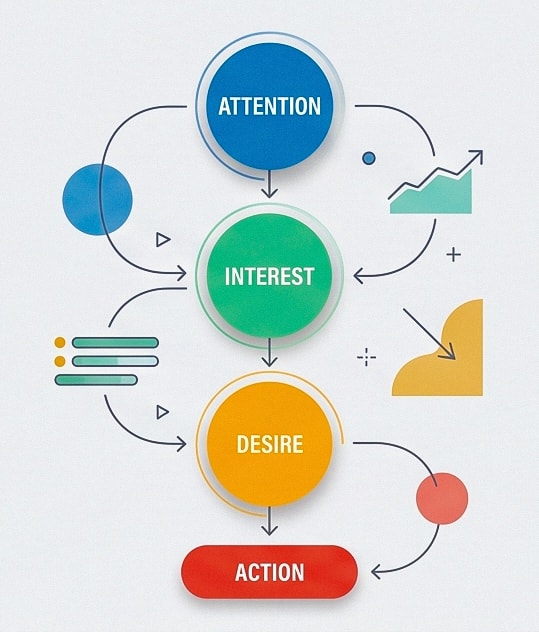
But just like a clean layout where the grid lines are invisible, a well-written caption relies on restraint. The rule here is to “remove the scaffolding.” The reader should feel the structure without ever seeing its labels. When it’s done right, nobody reading your caption thinks, “ah, that’s a PAS post.” There is nothing to untangle, nothing competing for the eye, just a clear path from the first line to the last.
Transformation is a design move too
Designers are natural storytellers, whether the medium is a before-and-after slide, a rebrand reveal, or a portfolio piece built entirely around a client’s transformation. That instinct has a direct copywriting equivalent in the book’s BAB formula (Before, After, Bridge) and PPPP formula (Picture, Promise, Prove, Push), both built around painting a clear picture of change and then proving it’s real. If you already think in visual transformation, these two formulas will probably feel the most natural of the sixteen.
What’s actually inside the book?
Each of the sixteen chapters follows the same format: how the formula works, when to reach for it, a realistic example post written for a fictional business, a line-by-line breakdown of why the example works, and a clear list of do’s and don’ts drawn from real practice.
You’ll find familiar names like AIDA and PAS next to formulas most people have never heard of, like OATH, QUEST, and PAIS, often the most useful precisely because almost nobody else in your feed is using them.
Past the sixteen chapters, there’s a full toolkit built for daily use:
- A decision guide that matches your goal (selling, teaching, launching, or winning someone over from a competitor) to the right formula
- A platform breakdown covering Instagram, LinkedIn, X and Threads, TikTok and Reels, and paid ads, so you know which formulas actually fit the fold and attention span of each one
- A library of fill-in-the-blank hooks and closing lines
- A one-page quick reference to all sixteen formulas
Ready to give your words a grid?
Get your copy on Google Play:
Comments are closed.